 ),
the mean and variance of the distribution. Within ClusterSeer, lambda
is the average or expected case count, calculated from the average or
expected disease frequency multiplied by the population-at-risk.
),
the mean and variance of the distribution. Within ClusterSeer, lambda
is the average or expected case count, calculated from the average or
expected disease frequency multiplied by the population-at-risk. The null hypothesis of a Poisson disease rate is usually a good representation
of randomly distributed non-infectious rare diseases (Waller
and Jacquez 1995). It
is used in many cluster detection methods in ClusterSeer, including Besag and Newell's method. A Poisson
function can be described by one parameter, lambda ( ),
the mean and variance of the distribution. Within ClusterSeer, lambda
is the average or expected case count, calculated from the average or
expected disease frequency multiplied by the population-at-risk.
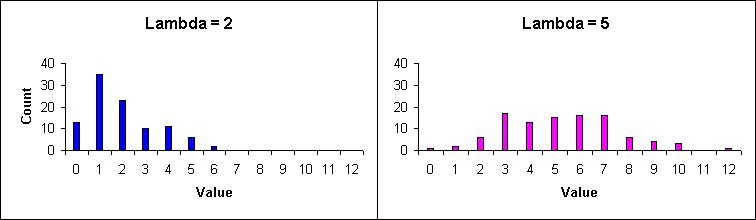
Poisson point process models are used for null
and alternative spatial models in Diggle's
Method and Ripley's K-function.
Poisson point processes produce sets of points with a given intensity
( , the mean and variance of the Poisson distribution),
an expected number of points or cases per unit area.
