SpaceStat, ClusterSeer & BoundarySeer Are Now Part of Vesta
For more than three decades, BioMedware’s SpaceStat, ClusterSeer, and BoundarySeer set the standard for space-time analysis, cluster detection, and boundary analysis. Today their successor carries that work forward — the methods they pioneered have been rebuilt, expanded, and unified inside our current platform, Vesta.
If you arrived here from one of the legacy product pages, or you’re evaluating a replacement for a tool you’ve used for years, this page explains where each capability lives now, what’s new, and how to migrate.

Why we consolidated three products into one
The original BioMedware product line was built when running spatial analysis meant choosing a specific tool for a specific question. That created friction: a project that needed both cluster detection and kriging meant two licenses, two interfaces, and manually stitching results together.
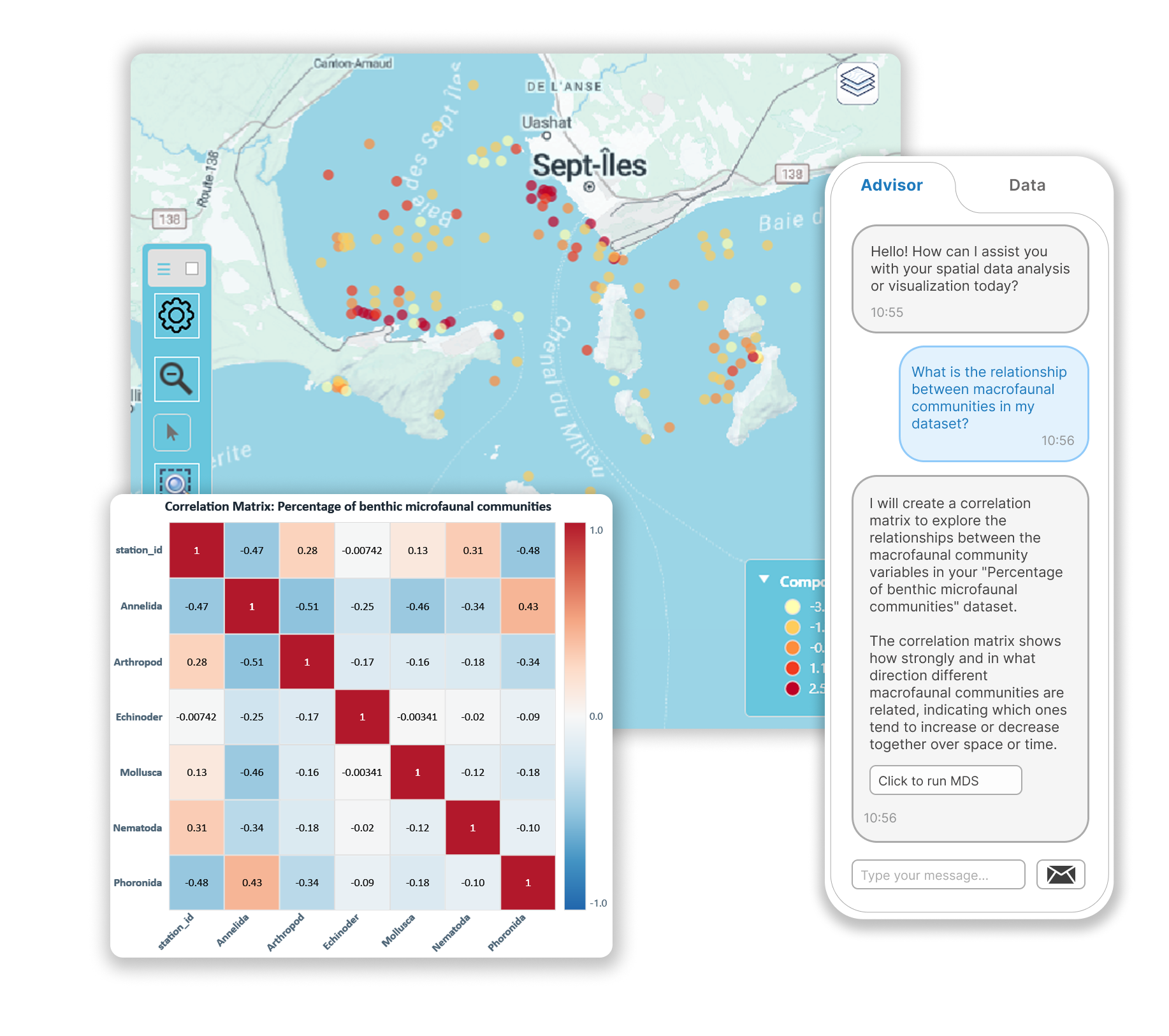
Vesta brings all of that into a single platform where every method shares the same data and visualizations, and an AI Advisor guides the workflow in plain language. The same peer-reviewed methods you trusted in SpaceStat, ClusterSeer, and BoundarySeer are still here; they’re just easier to find, faster to run, and built for modern data sources.
Where your favorite capabilities live now
SpaceStat introduced the idea of time as a true dimension of spatial data. That foundation is now native to Vesta and runs across every analysis method.
| SpaceStat Capability | In Vesta |
|---|---|
| Animated maps, histograms, and tables over time | Dynamic Data Visualization & Animation with time slider, linking, and brushing across all views |
| Linear, Poisson, and logistic regression | Linear Regression, Logistic Regression, plus 9 machine-learning regression algorithms |
| Geographically Weighted Regression | GWR — standard and logistic variants |
| Spatial aggregation (point ↔ polygon, geography to geography) | Spatial Aggregation with multiple methods |
| Excel and Office-format import | Smart Data Import — auto-detects time columns, coordinates, data types, and missing values |
| Copy maps and graphs to clipboard | Same, plus full DOCX and PDF report export with embedded AI Advisor narrative |
New in Vesta beyond what SpaceStat offered: spatio-temporal kriging with 3D Product-Sum variogram models, joinpoint regression for temporal trend analysis, multidimensional scaling to explore and cluster time series with similar trends, compositional data analysis (ALR/CLR/ILR transformations), uncertainty modeling using indicator kriging, cross-validation of kriging results, categorical variables in variograms and kriging, cokriging with automatic modeling of coregionalization, and direct connections to CDC, Census, WAHIS, FAOSTAT, EPA, and USGS data feeds. In addition, after running each method a report is automatically created which summarizes and interprets the main results.
ClusterSeer‘s cluster-detection methods now sit alongside the rest of your analysis instead of in a separate application.
| ClusterSeer Capability | In Vesta |
|---|---|
| Local and global spatial clustering | Local Cluster Analysis with Local Moran's I, hotspot/coldspot detection, and spatial outlier identification |
| Temporal and space-time clustering | Local cluster analysis combined with time-slider animation and spatio-temporal kriging |
| Cluster Advisor (rule-based guidance) | AI Advisor — LLM-powered conversational guidance with method recommendations, real-time diagnostic caveats, and 50+ pre-built analysis actions |
| Statistical results log | Analysis summaries with DOCX/PDF export and a full record of the AI Advisor conversation |
If you were a ClusterSeer user, the biggest day-one upgrade is the AI Advisor. Instead of consulting a static expert system, you can ask “are these clusters statistically meaningful given my sample size?” or “what’s the right adjustment for multiple comparisons here?” and get a context-aware response that references your actual data.
BoundarySeer‘s role was identifying transitions and boundaries in spatial data and assessing whether they were statistically meaningful. In Vesta, that work is done through a combination of cluster analysis, kriging surfaces, and indicator methods — with the same emphasis on quantifying whether patterns are real or due to chance.
| BoundarySeer Capability | In Vesta |
|---|---|
| Detection of spatial pattern and rates of change | Local Cluster Analysis combined with kriging-based surface modeling |
| Delineation of like areas and spatially constrained clustering | Local cluster analysis plus indicator kriging for thresholded surfaces |
| Statistical inference on patterns | Cross-validation (LOOCV, K-Fold, train/test split), variogram diagnostics, and significance testing across methods |
| Boundary Advisor and Boundary Wizard | AI Advisor with workflow templates and intelligent parameter guidance |
| Data preparation (Delaunay triangulation, standardization) | Grid operations and Variable Operations (log transform, change of scale, binary creation) |
A note for BoundarySeer users: if your work depends on a specific wombling implementation or boundary-overlap statistic, contact us before migrating. We are currently working on implementing this feature, and will make an announcement when it is available. Feel free to reach out with any questions.
What you gain when you switch
- AI Advisor Ask questions in natural language, get method recommendations, parameter suggestions, and real-time diagnostic warnings. Export the full conversation as documentation suitable for manuscripts or agency submissions.
- 43+ Built-in Data Connections CDC BRFSS and CDI, US Census ACS and Decennial, WAHIS animal disease surveillance, FAOSTAT, EPA, USGS, and more — no manual download or reformatting required.
- Smart Import for Everything Else Drop in a CSV, Excel file, shapefile, GeoTIFF, or dBASE file. Vesta detects time columns, coordinates, and data types automatically.
- Machine Learning, Built In Nine algorithms for regression and classification with feature importance, ROC curves, and prediction on new datasets.
- Native Space-Time Analysis Spatio-temporal kriging with 3D variogram models — true space-time interpolation, not just animated 2D snapshots.
- One License, Every Feature No add-ons, no plugins, no per-method upcharges. An annual subscription covers all features.
- No Environment Headaches Runs on Windows 10 or later with no Python environment, no ArcGIS license, no complex dependencies.
Migrating from a legacy product
- Start the free trial. All features unlocked for 30 days.
- Try your existing data. Vesta reads the same CSV, Excel, and shapefile formats your legacy projects used. Most existing files can be re-imported directly.
- Ask the AI Advisor to recommend an analysis path for your data. It's designed for exactly this situation: a returning user with a familiar question and an unfamiliar interface.
- Need help recreating a specific analysis? Email support@biomedware.com — we'll help map your SpaceStat, ClusterSeer, or BoundarySeer workflow to Vesta's methods.