Polygon contiguity
ClusterSeer can derive neighbor relationships
from a file of polygons. In essence, ClusterSeer will evaluate whether
the polygons share a border with each other or overlap. If they share
a border or overlap, they are considered neighbors. In order to derive
neighbor relationships from polygons in shapefile
format, you must specify how ClusterSeer should evaluate these relationships.
While it may seem like a trivial concept, in fact the specification of
neighbor relationships can influence the outcome of statistical analyses.
Rook vs. queen
Two options are available—rook
and queen—their
names come from the movements of chess pieces. The rook can move only
to polygons that share a border of some length with its current polygon.
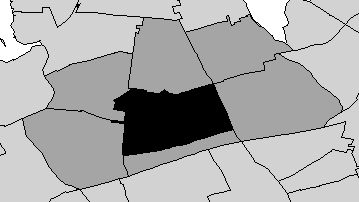
In the figure below, the rook, illustrated as the central black polygon,
can move only to the five dark gray polygons that share borders of some
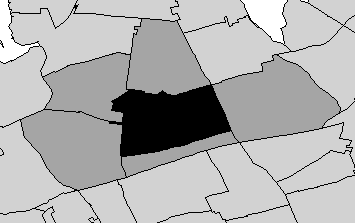
length with it. The queen in the second figure below can move to any polygon
that shares even a point-length border. So, she can move to the rook's
polygons and to any polygon that shares a corner (one vertex) with her
current polygon. That gives the queen a total of six adjacent polygon
neighbors.
Thus, rook is a more stringent definition of polygon contiguity than
queen—for
rook the shared border must be of some length, whereas for queen the shared
border can be as small as one point.
Rook
Queen