Both techniques require grouping the data into classes, or clusters.
In fuzzy classification, the classes are based on variable values, irrespective
of spatial location. In spatially-constrained clustering, as the name
suggests, group membership is constrained by the spatial location, i.e.
distant locations with similar values will not be grouped together.
For both methods, k-means clustering begins and ends with a fixed number
of classes (or clusters). Class memberships are rearranged through an
iterative process in order to optimize the classification, using the following
criteria:
minimize within-cluster variation using the sum of squares
error term (SSE)
minimize within-class variation
using the sum of squares error term (SSE)
(after Bezdek et al. 1984)
refinement method
At each iteration, all locations that can
change cluster membership are identified. To qualify for a change of membership
to a new cluster, a location must be adjacent to a member of the new cluster,
and its removal from its former cluster cannot cause the former cluster
to become discontinuous. The membership change that causes the greatest
decrease in the total within-cluster SSE is then made. The process repeats
until no allowable membership relocation improves the SSE.
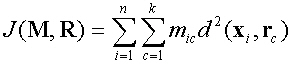
When f
> 1, J can be minimized by Picard iteration of the following equations:
Where,M
= (mic)
is a matrix of class memberships,
R = (rcv) is a matrix
of class means, rcv,
denoting the mean of class c for variable v,
xi
= (xi1,...,xip)T is the vector representing values
of the p variables at location i,
rc
= (rc1,...,rcp)T is the vector representing the
center of class c in terms of means of the p variables,
d2(xi,rc)
is the square distance between xi and rc,
also expressed as dic2.
f is the fuzziness criterion ( f=
1 gives hard clusters and is required for spatially constrained clustering;
f= 2
is a good minimum value for fuzzy clustering McBratney
and de Gruijter 1993).
e is the stopping criterion, which determines the level of convergence
necessary before quitting (McBratney and de Gruijter
1993 recommend e
= 0.001).