
|
Moran's I (Moran 1950) is a weighted correlation coefficient used to detect departures from spatial randomness. Moran's I is used to determine whether neighboring areas are more similar than would be expected under the null hypothesis. Oden (1995) adjusted Moran's I to account for differences in population size across areas. Use Ipop when population size data are available.
Ipop requires a fair amount of notation. In essence, it is large when there is clustering within a region or among adjacent regions.
|
|
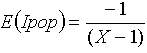
The expectation of Ipop under the null hypothesis (no clustering) approaches zero for large total population:
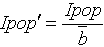
The range of Ipop depends on population size, therefore t can be useful to standardize the statistic using the average prevalence, for comparison among different study areas.
The variance of Ipop can be determined based on a random distribution, appropriate for disease rates (Cliff and Ord 1981). ClusterSeer calculates the variance in two ways. The variance of Ipop under the null hypothesis is:

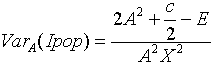
It also calculates an approximation of the variance (VarA):
ClusterSeer evaluates the significance of Ipop using three approaches: using the z-scores and variance calculated in each way and through Monte Carlo randomization, using multinomial randomization. In general, these three methods will report relatively similar p-values. The approximation and randomization assumption methods are only valid when the data can be assumed to be distributed normally. When the data may not be normally distributed, use the Monte Carlo p-value instead.

